
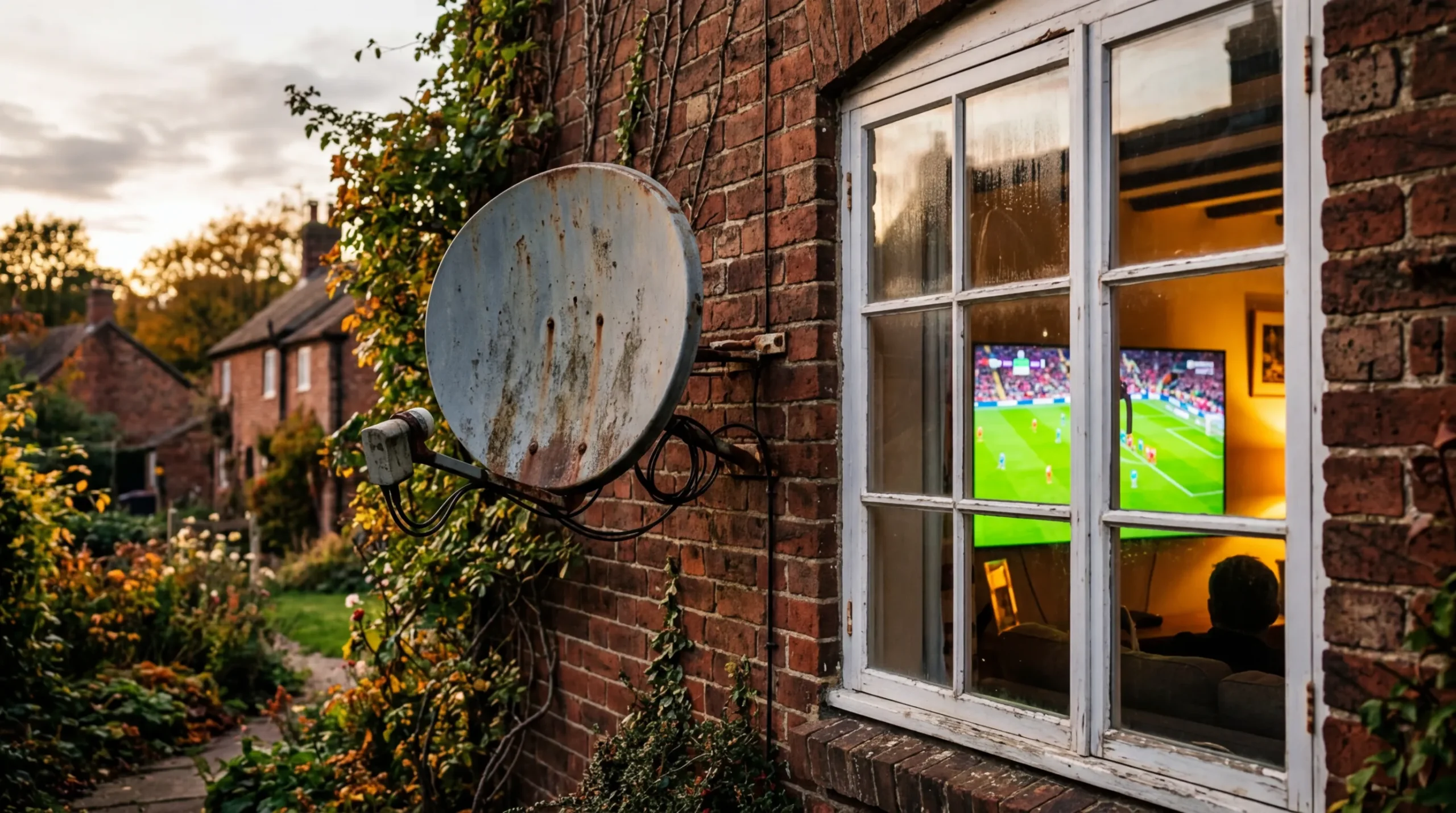
There is a satellite dish on the side of millions of UK homes. Some of them have been there for twenty years. They weathered every storm, survived multiple house moves, and delivered television reliably through the pre-streaming era. For a generation of UK viewers, the dish is simply part of the house.
But something has changed. Sky — the dominant satellite TV provider in the UK — has been quietly moving its own future away from the dish and toward broadband delivery. Its broadcast agreement with satellite operator SES extends only to 2029. Sky Glass and Sky Stream run entirely over IPTV without a dish. The message from the UK’s biggest satellite broadcaster is clear: the dish era is ending.
For UK households still paying for a satellite TV package, the question is not really IPTV vs Satellite TV UK as a theoretical comparison. It is whether to get ahead of an inevitable transition now, on your own terms, at a time and price of your choosing — or to stay with a legacy technology that the industry is already walking away from.
How Satellite TV Works in the UK — and Why It Is Becoming Obsolete
Satellite television delivers content by broadcasting signals from satellites in geostationary orbit — primarily the Astra 2 cluster at 28.2 degrees east — down to dish receivers mounted on UK properties. The dish captures the signal and passes it to a set-top box, which decodes it and delivers picture and sound to your television.
For decades, this was the most practical way to deliver a large channel lineup to UK households. It required no physical cable infrastructure, worked across the country regardless of location, and delivered consistent signal quality. Sky built an empire on this technology.
Why the Industry Is Moving On
The problem with satellite is that it is expensive to operate, inflexible by nature, and increasingly unnecessary as UK broadband infrastructure improves. Maintaining a satellite broadcast requires ongoing investment in transponder capacity — and the broadcast agreement between Sky and satellite operator SES, which was only recently extended, runs only until 2029. That is not a long runway for a technology that costs significant money to operate.
Sky itself has already built its post-satellite products. Sky Glass is a streaming television delivered entirely over broadband with no dish. Sky Stream is a puck-sized IPTV device that replaces the traditional Sky box without requiring a dish installation. Sky is essentially running two parallel businesses — the satellite legacy system and the IPTV future — and it is increasingly obvious which one they are investing in.
What This Means for Current Satellite TV Customers
If you are currently a Sky satellite customer, your service is not going anywhere tomorrow. But within the next several years, the satellite delivery infrastructure will be wound down and replaced with IPTV-based alternatives. Getting ahead of this transition now means making the switch on your own terms, at a time that suits you, rather than being forced into a change you did not plan for.
What Satellite TV Does Well — the Honest Assessment
Before making the case for IPTV, it is only fair to acknowledge what satellite TV does genuinely well. It has served UK households for three decades for good reasons.
Works Independently of Broadband
A satellite signal arrives at your dish regardless of your broadband speed, your internet provider, or how many other people in your street are online simultaneously. For households in rural areas with genuinely poor broadband — where fibre has not reached and connections are slow or unreliable — satellite’s independence from broadband infrastructure is a real and meaningful practical advantage.
Broad UK Geographic Coverage
The satellite signal covers the entire UK footprint without exception. Urban, rural, remote Scottish highlands, offshore islands — if you have a line of sight to the satellite and a dish on the wall, you get the full channel lineup. IPTV depends on broadband, and while UK broadband coverage is extensive and improving, it is not yet universal at the speeds IPTV requires.
Mature and Familiar Technology
Sky’s satellite platform has been refined for decades. The EPG is excellent. The hardware is reliable. Customer service — while sometimes frustrating — is backed by a large, established organisation. For viewers who have used Sky satellite for years and find it completely reliable, the argument for switching is primarily financial and future-focused rather than quality-driven.
Where IPTV Wins Clearly
For the majority of UK households — particularly those in urban and suburban areas with decent broadband — IPTV wins the comparison with satellite on almost every dimension that matters in 2026.
No Dish, No Engineer, No Installation
IPTV runs over your existing broadband connection. There is nothing to install on the outside of your property, no engineer visit to schedule, no planning permission to consider, and no landlord approval to seek. For renters, flat dwellers, and anyone in a property where a satellite dish is impractical or not permitted, IPTV removes a barrier that satellite cannot overcome.
Every Device, Every Room, On the Move
A satellite signal reaches one dish, connected to one or two set-top boxes, in fixed locations in your home. IPTV reaches every device you own — smart TV in the living room, tablet in the bedroom, phone on the commute, laptop anywhere with WiFi. For modern UK households where different family members watch different content on different devices simultaneously, IPTV’s flexibility is not a luxury. It is a basic expectation.
Dramatically Lower Monthly Cost
Sky’s satellite TV packages are not cheap. A mid-tier Sky package with sports channels runs from £60 to £100 per month depending on the bundle. A quality IPTV suppliers UK service delivering the same channel content — all live UK broadcasters, sports channels, on-demand library — typically costs £10–20 per month. The saving over the course of a year ranges from £500 to £1,000 for equivalent content.
No Weather Dependence
Anyone who has watched a satellite dish lose signal during heavy rain, snow, or a strong wind knows the frustration of the screen going blank at the worst possible moment. IPTV delivers content over broadband — the same infrastructure that powers your email, your banking, and your work video calls. Broadband is not weather-dependent in the way that a satellite signal is, and for live sports viewing in particular this reliability difference matters.
Future-Proof Technology
This is the clearest argument for switching now. Satellite TV is a legacy technology that the UK’s biggest broadcaster is already transitioning away from. IPTV is the delivery mechanism that Sky, the BBC, ITV, and every major UK broadcaster is building toward. Choosing IPTV in 2026 is not switching to an alternative — it is switching to what the industry has already decided is the future.
For a detailed look at what makes a quality IPTV supplier, see our best IPTV suppliers UK guide and our IPTV suppliers vs providers UK guide. For access setup guidance, see our how IPTV access works in the UK guide.
If you are ready to cut the dish and want to land on an IPTV service that actually delivers — stable streams, a complete UK channel lineup, live sport, and support that picks up when you call — Golden TV is the service UK viewers consistently point to. It does everything your satellite dish does, on every device you already own, without a contract, without an engineer, and for a monthly cost that makes the satellite bill look like an obvious mistake. Message the team on WhatsApp before you subscribe and they will answer every question you have.

*Recommended based on user feedback from UK IPTV communities. We do not operate or sell IPTV services directly.
What Broadband Speed Do You Need to Replace Satellite with IPTV?
This is the practical question that matters for households considering the switch. The answer is more accessible than most people expect.
For stable HD streaming — which covers the overwhelming majority of live TV and sports viewing — a minimum of 15 Mbps download speed dedicated to your streaming device is sufficient. For 4K content, 25 Mbps or above is recommended. The average UK broadband speed in 2026 significantly exceeds these thresholds in most areas.
A wired ethernet connection — rather than WiFi — is always preferable for live sports viewing. It eliminates the variability and interference that causes buffering during crucial match moments, and most streaming devices support ethernet through a simple and inexpensive adapter.
Households in rural areas with genuinely slow broadband — below 10 Mbps reliably — may find that satellite remains the more practical option until their local broadband infrastructure improves. But this applies to a diminishing proportion of UK households as fibre rollout continues.
Frequently Asked Questions – IPTV vs Satellite TV UK
Is IPTV better than satellite TV in the UK?
For most UK households in 2026, yes. IPTV delivers the same channels on more devices, with no weather dependence, no dish installation, no contracts, and at dramatically lower monthly cost. The one scenario where satellite still wins is households with genuinely poor broadband connectivity — typically rural areas where fibre has not yet reached. For everyone else, IPTV is the more practical, more flexible, and more affordable option.
Will satellite TV be switched off in the UK?
Sky’s broadcast agreement with satellite operator SES runs only until 2029. Sky has already launched dish-free IPTV alternatives — Sky Glass and Sky Stream — and is clearly transitioning its business away from satellite delivery. While there is no confirmed switch-off date, the direction of travel in UK broadcasting is unmistakably toward IPTV. Satellite TV will continue to operate for several years, but investing in satellite infrastructure now means potentially facing a forced transition within three to six years.
Do I still need a satellite dish if I use IPTV?
No. IPTV delivers all content through your broadband connection. Your satellite dish becomes completely redundant the moment you switch. Some households keep it as a backup for periods of broadband outage, but for day-to-day viewing an IPTV service makes the dish unnecessary.
Can I get Sky Sports without a satellite dish?
Yes — in two ways. Sky offers Sky Glass and Sky Stream as dish-free IPTV alternatives to its satellite service. Alternatively, a quality IPTV service includes Sky Sports channels live without any Sky subscription, satellite dish, or broadband bundle. The IPTV route is typically significantly cheaper than either Sky product.
Is IPTV affected by bad weather like satellite TV?
No. IPTV delivers content over broadband and is not affected by rain, wind, or snow in the way that satellite signals are. Satellite dishes lose signal during heavy precipitation because the signal strength is reduced below the threshold needed to decode the broadcast. Broadband is a ground-level infrastructure connection not subject to atmospheric interference.
What happens to my Sky channels if I cancel and switch to IPTV?
All the channels currently in your Sky package — Sky Sports, Sky Cinema, BBC, ITV, and everything else — are included in a comprehensive IPTV service. The content is identical. The delivery mechanism changes from satellite to broadband. Most household viewers notice no practical difference in what they can watch — they just notice a significantly lower monthly bill.
Is it cheaper to use IPTV than Sky satellite in the UK?
Significantly. A mid-tier Sky satellite bundle costs £60–100 per month. A quality IPTV service covering the same channels costs £10–20 per month. The annual saving ranges from £500 to £1,000 for equivalent content. Even adding a broadband-only contract to replace a Sky bundle, the combined cost is almost always lower than the Sky satellite subscription it replaces.
Final Verdict – Should You Cut the Dish?
If your broadband connection reliably delivers 15 Mbps or above — and for the majority of UK households in 2026 it does — cutting the satellite dish and switching to IPTV is one of the clearest value decisions available to a UK television viewer.
The content is the same. The picture quality is comparable. The cost saving is substantial. The flexibility is incomparably better. And the technology you are switching to is where the entire UK broadcasting industry is already headed — Sky included.
The dish had a good run. But in 2026, it is a legacy technology with a countdown clock attached to it. IPTV is the present and the future of UK television delivery. The only question is whether you make the switch now, on your own terms, or wait until the industry forces the decision for you.
Satellite TV had its moment. But with Sky’s own broadcast agreement only secured until 2029 and the entire UK broadcasting industry investing in broadband delivery rather than dish infrastructure, the direction of travel is unmistakable. IPTV is what comes next — and Golden TV is a solid place to start that transition. Complete UK channels, live sport, no dish required, and a team you can actually reach on WhatsApp when something needs sorting. Get in touch and see what replacing your satellite dish actually looks like.
Disclosure: This site recommends third-party services based on user feedback and research. We do not operate, sell, or provide IPTV services directly. All trademarks belong to their respective owners.